


SATAN FEARS THOSE WHO DISCOVER THIS SECRET: DON'T LET YOUR WOUNDS DECIDE FOR YOU!
Discover the P.A.C.E. Method: 4 Gospel-Inspired Steps to Face Prophetic Spiritual Warfare and Learn from Jesus How to Respond to Attacks Without Losing Your Peace
INTRODUCTION
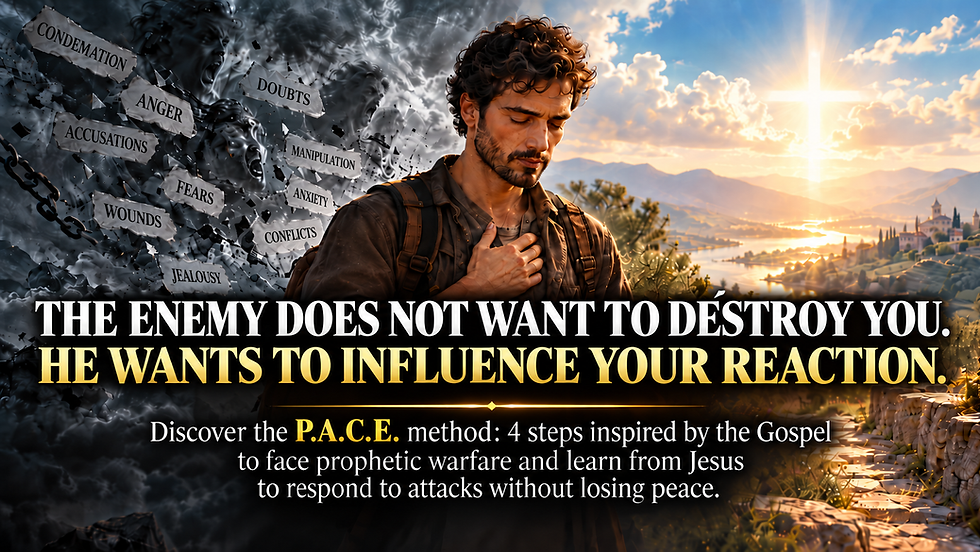
The enemy does not want to destroy you.
He wants to influence the way you react!
There is a truth you absolutely need to understand if you want to persevere in your calling: the enemy does not always need to destroy you directly. Sometimes, all he needs to do is influence how you react to what happens to you.
Have you ever said something in the depths of suffering that damaged an important relationship?
Have you ever made a decision when you were deeply hurt, angry, or disappointed, only to regret it bitterly afterward?
Have you ever considered leaving the Church, a community, a ministry, a friendship, or even your mission because someone humiliated you, betrayed you, slandered you, or simply failed to recognize your worth?
And how many times, once you had calmed down, have you thought: “If I had waited before speaking, perhaps things would have turned out differently”?
Not every spiritual battle is won by reacting.
Some battles are won precisely by refusing to react the way the enemy wants you to.
Satan, the divider, seeks to slip into our vulnerabilities. He can exploit our feelings and emotions, our anger, our fear, our wounded pride, and our desire for recognition to push us toward choices that weaken our communion with God and with our brothers and sisters.
Be careful: this does not mean that every negative emotion comes from the devil, or that every conflict is a spiritual attack. It means recognizing that our reactions can become a ground for temptation when we stop discerning.
And this is where the Gospel reveals something extraordinary.
When we observe how Jesus faces temptations, provocations, accusations, and even betrayal, we discover an inner freedom that psychology and neuroscience can help us understand more clearly today.
Jesus does not allow his attackers to determine the direction of his choices. He does not let the hostility of others govern his heart. He recollects himself, prays, remains rooted in the Father's will, and acts in truth.
This is not passivity. It is spiritual freedom. And it is a fundamental lesson in emotional regulation.
1. WHEN THE BRAIN FEELS THREATENED:
WHY DO WE REACT BEFORE WE THINK?
Imagine this situation... You have devoted months to a mission. You have prayed, organized gatherings, accompanied people, and sacrificed time and energy. Then, suddenly, you receive a message full of accusations.
Someone questions your sincerity. A brother misinterprets your intentions. Someone you considered a friend speaks badly of you.
You read those words, and immediately you feel something change inside you.
Your heart races. Your breathing quickens. You feel under attack.
You want to reply immediately. You want to defend yourself. Perhaps you want to inflict on that person all the pain they have caused you.
What is happening?
The brain can interpret rejection, humiliation, or verbal aggression as a significant threat.
Various systems involved in the stress response become activated, including the amygdala, a brain structure that plays an important role in processing emotions and signals of danger.
Under intense stress, our ability to reflect, plan, and control impulses—functions in which the prefrontal cortex plays an important part—can become more difficult to use effectively.
In popular psychology, this phenomenon is sometimes called emotional hijacking.
This does not mean that the brain stops reasoning. It means that emotional arousal can become so intense that it influences our judgment.
Generally, when facing a threat, three reactions may emerge:
Fight: I attack, accuse, raise my voice, or seek revenge.
Flight: I break off a relationship, distance myself from the community, or abandon a ministry.
Freeze: I withdraw into myself, lose confidence, and can no longer make decisions or face the situation.
These are human responses to stress, not necessarily signs of spiritual weakness.
But when these reactions become automatic, we risk making decisions that do not reflect our deepest values.
The Window of Tolerance
Psychiatrist Daniel J. Siegel helped popularize the window of tolerance model, used in the psychology of stress and trauma.
This model describes a state in which we are able to recognize our emotions, process information, and maintain a sufficient capacity for discernment.
When emotional arousal becomes excessive, we may move outside this window in two main ways:
Hyperarousal, marked by agitation, anger, anxiety, and impulsivity.
Hypoarousal, marked by withdrawal, detachment, immobility, and a sense of helplessness.
It is precisely in these states that it becomes harder to calmly evaluate the consequences of our words and decisions.
The Word of God offers us wise guidance:
“Let everyone be quick to listen, slow to speak, slow to anger” (James 1:19).
This exhortation does not ask us to suppress our emotions.
It invites us not to let our impulses govern our actions.
Spiritual maturity does not mean no longer feeling emotions, but learning not to be ruled by them.
2. JESUS IN THE WILDERNESS:
DO NOT LET THE ENEMY DECIDE WHO YOU ARE
In the Gospel according to Matthew, we find Jesus in the wilderness after forty days of fasting (Matthew 4:1–11). He is hungry. He is experiencing genuine physical vulnerability.
The tempter approaches him with a provocation:
“If you are the Son of God...” (Matthew 4:3).
Consider these words. The tempter is not merely trying to exploit Jesus' hunger. He wants to push him to prove his identity on terms that do not come from the Father.
It is as though he were saying: “If you truly are the Son of God, prove it!”
How often do we experience something similar?
Someone questions our faith, and we feel the need to prove that we are good Christians.
Someone criticizes our ministry, and we want to defend our reputation immediately.
Someone fails to recognize what we have done, and we feel deeply devalued.
But Jesus refuses to build his identity upon the enemy's provocation.
He responds with the Word of God.
He does not try to impress the tempter.
He does not need to prove his dignity.
Jesus remains faithful to the Father.
Here is a first great rule of spiritual warfare: do not let the person who provokes you determine the worth of your identity.
You are not what others say about you.
You are not the criticism you have received.
You are not the rejection you have suffered.
You are not the failure you have experienced.
You are a beloved child of the Father, called to live in the freedom of God's children.
And when you are rooted in that identity, you no longer need to win every argument to feel that you matter.
The enemy tries to make you react in order to prove who you are. The Holy Spirit reminds you who you are so that you can act in freedom.
3. JESUS WITHDRAWS TO PRAY:
NOT EVERY PROVOCATION DESERVES AN IMMEDIATE RESPONSE
In the first chapter of the Gospel according to Mark, Jesus has just had an intense day. He has preached, healed the sick, and delivered people who were oppressed.
Everyone seems to need him.
Yet the next morning, he withdraws to a deserted place to pray (Mark 1:35).
When the apostles find him, they say:
“Everyone is searching for you!” (Mark 1:37).
The pressure is intense. There are expectations, requests, and needs.
But Jesus does not allow the crowd's urgent demands to take the place of the Father's will.
He remains free to continue his mission.
This episode contains a precious lesson for each of us, especially those engaged in pastoral or missionary service.
Not every urgent demand from others is a call from God for you.
Not every criticism requires an immediate explanation.
Not every provocation deserves a response.
Not every expectation has to be met.
And above all, not every decision should be made while we are experiencing intense emotions.
Sometimes we think that stopping means wasting time.
In reality, stopping can keep us from causing harm.
We think we must reply immediately to an offensive message.
We think we must justify every one of our choices.
We think that remaining silent for a few hours means admitting that our accuser is right.
But Jesus teaches us that recollection and prayer can become places of genuine freedom.
A missionary who does not know how to stop risks confusing the voice of the Holy Spirit with the noise of their own wounds.
Prayer is not an escape from responsibility.
It is the place where we can recover the discernment needed to face our responsibilities.
4. THE WOMAN CAUGHT IN ADULTERY:
JESUS DOES NOT FOLLOW THE PACE SET BY HIS ACCUSERS
Let us consider one of the most surprising episodes in the Gospel (John 8:1–11).
The scribes and Pharisees bring before Jesus a woman caught in adultery.
They ask him to pronounce judgment on her condemnation.
The Gospel explains that they want to test him in order to find grounds for an accusation. It is a trap. Everyone is waiting for an answer. His accusers persist.
But Jesus makes an unexpected, prophetic gesture:
“Jesus bent down and wrote with his finger on the ground” (John 8:6).
The text does not explain the meaning of this gesture. We therefore cannot attribute a particular intention to it with certainty. Nevertheless, we can contemplate the freedom with which Jesus faces the provocation.
He does not allow himself to be trapped in the aggressiveness of those confronting him.
He does not allow them to control the direction of his response.
And when he speaks, his words open up a space for truth and mercy.
Jesus does not react to defend his pride.
He intervenes to call everyone back to the truth.
How many family or community discussions could change if we learned to preserve this space of freedom!
Before sending a message full of anger, we could stop.
Before judging a brother, we could listen to him.
Before abandoning a mission, we could ask ourselves whether we are acting in freedom or out of bitterness.
Who is setting the pace of your responses: the Holy Spirit or the person provoking you?
This is a question worth bringing into prayer.
5. GETHSEMANE:
JESUS DOES NOT SUPPRESS HIS ANGUISH,
HE BRINGS IT THROUGH PRAYER
We come to one of the most intense moments in Jesus' life.
In Gethsemane, the Lord experiences extremely profound suffering.
He knows that his Passion is approaching.
He knows the betrayal, abandonment, and violence he will have to face. Yet he does not pretend that everything is fine. He does not conceal his anguish. He does not try to present himself as someone who feels no emotions. He prays:
“Yet not my will but yours be done” (Luke 22:42).
And the evangelist adds:
“In his anguish he prayed more earnestly” (Luke 22:44).
Let us dwell on this expression: In his anguish he prayed more earnestly.
Jesus' response is not to deny what he is experiencing.
He brings his suffering into his relationship with the Father.
We can see that Jesus' secret points toward something psychology would articulate many centuries later: emotional regulation is not the suppression of emotions.
It does not mean becoming cold or insensitive.
It means learning to recognize what we are experiencing, to understand it, and not to turn every impulse automatically into behavior.
Jesus teaches us that we can go through even very painful emotions without losing our orientation toward the Father.
You can be afraid and remain faithful.
You can be tired and continue to love.
You can be wounded and refuse to wound others.
You can experience an inner battle without turning it into a war against your brothers and sisters.
Christian courage does not mean no longer feeling emotions, but refusing to let them decide in place of faith.
6. PETER DRAWS HIS SWORD, JESUS HEALS:
TWO RESPONSES TO THE SAME ATTACK
There is an episode that I find particularly meaningful.
When Jesus is arrested, Peter draws his sword and strikes Malchus, the high priest's servant, wounding his ear (see John 18:10).
Peter loves Jesus. He wants to defend him. But his reaction is impulsive. Jesus intervenes:
“No more of this!” (Luke 22:51).
And Luke tells us that Jesus touches the man's ear and heals him.
Let us contemplate this scene.
Peter, facing a threat, wounds. Jesus, in the same situation, heals.
What an extraordinary contrast! Both face an act of aggression, but their responses are completely different.
Peter reacts violently. Jesus remains faithful to his saving mission.
How important this lesson is for our communities!
Sometimes we believe we are defending the Church, yet we end up hurting people.
We think we are protecting a mission, yet we fuel divisions.
We believe we are defending the truth, yet we use words that destroy the dignity of others.
Of course, this does not mean that Jesus was passive.
He denounced hypocrisy and firmly confronted injustice, as the episode in the Temple also shows (see John 2:13–17).
Inner freedom does not mean avoiding every conflict.
It means not allowing emotions to take the place of conscience and discernment.
7. WHEN WOUNDS BECOME DIVISIONS:
THE REAL DANGER WITHIN COMMUNITIES
I would now like to address missionary disciples in particular.
Sometimes the most painful divisions in Christian communities begin with seemingly insignificant situations:
A word that has been misunderstood.
A service that goes unrecognized.
Criticism received in front of others.
A leader's decision we do not understand.
A message that goes unanswered.
A promise that is not kept.
At first, there is a wound. Then the wound can turn into suspicion. Suspicion feeds judgment. Judgment becomes resentment. And resentment, when nurtured, can destroy communion.
The brother who prayed beside you yesterday begins to look like an adversary.
The person you considered a friend becomes the target of your criticism.
The community you loved suddenly seems like a place you need to leave.
It is precisely in these situations that we need spiritual vigilance.
Saint Paul writes:
“Be angry but do not sin” (Ephesians 4:26).
And immediately afterward he adds:
“Do not make room for the devil” (Ephesians 4:27).
What an important connection! The apostle does not say that every feeling of anger is sinful. He warns us against allowing anger to turn into behavior contrary to love.
The enemy can exploit an unhealed wound to turn personal suffering into division within a community.
But be careful: not every conflict is a demonic attack.
Not every criticism is persecution.
Not every disagreement is rebellion.
Sometimes there are genuine mistakes to correct, misunderstandings to clear up, or injustices to confront.
Christian discernment does not mean demonizing those who disagree with us.
It means seeking truth in charity.
And when we face abuse, manipulation, or violence, forgiveness does not mean giving up justice, the protection of people, or the need to set clear boundaries.
Communion is not born from imposed silence about problems, but from truth lived in love.
8. THE SECRET OF INNER FREEDOM:
BETWEEN THE WOUND AND THE RESPONSE, THERE IS A SPACE TO PROTECT
Modern research on emotional regulation, developed in part by psychologist James J. Gross, shows that we can learn to change how we interpret a situation and manage our emotional responses more effectively.
One of the strategies studied is cognitive reappraisal: looking at a situation from a different perspective, without denying the facts, in order to reduce the impact of excessively negative automatic interpretations.
No single strategy works in every circumstance.
But we can draw a fundamental lesson: we do not have to turn every emotion immediately into an action.
Between what happens to us and what we choose to do, we can cultivate a space for awareness, discernment, and freedom.
When someone provokes you, you can learn to pause.
When you feel humiliated, you can acknowledge your pain without immediately turning it into aggression.
When a situation overwhelms you, you can seek advice before making a decision.
When you feel like giving up everything, you can ask yourself whether you are choosing freely or reacting from a wound that is still open.
Of course, this does not mean it is always easy. Traumatic experiences and states of intense stress can make emotional regulation very difficult. Sometimes qualified psychological support is necessary and valuable.
Prayer and psychological support are not contradictory. They can help a person in different and complementary dimensions.
But for us as believers, there is also a deeper perspective.
The space between the wound and the response can become the place where we allow the Holy Spirit to enlighten our freedom.
It is not simply a matter of controlling ourselves.
It is a matter of learning to respond according to the Gospel.
9. THE P.A.C.E. METHOD:
4 STEPS TO STOP REACTING FROM YOUR WOUNDS
I would like to suggest a practical approach that is easy to remember and use in everyday life. I call it the P.A.C.E. Method (Pause – Acknowledge – Check – Enter God's Presence).
It is a human and spiritual exercise in discernment, inspired by Jesus' attitudes in the Gospel and by certain emotional regulation strategies.
It is neither a clinical protocol nor a magic formula, but it can become a valuable discipline for anyone who wants to grow in inner freedom.
1. P – PAUSE: do not let your impulses decide
When you are deeply distressed and no danger calls for immediate action, stop.
Do not send that message right away.
Do not make that phone call while anger is controlling you.
Do not make an important decision at the height of your discouragement.
Give yourself the time you need to regain clarity.
You can breathe slowly, temporarily step away from the situation, or take a moment of silence.
Sometimes a few minutes are enough. In other circumstances, you may need more time.
Pausing is not defeat. It is the first exercise of freedom.
2. A – ACKNOWLEDGE: recognize what you feel without judging yourself
Ask yourself:
“What am I really feeling?”
Anger? Sadness? Fear? Shame? Jealousy? A sense of rejection?
Then ask yourself:
“Why does this situation hurt me so deeply?”
Sometimes criticism in the present awakens an old wound.
A disagreement can revive the fear of abandonment.
A correction can bring back earlier experiences of humiliation.
Recognizing an emotion does not mean justifying every behavior.
It means learning to understand that emotion.
God does not ask you to pretend you are fine. He invites you to bring him what you are truly experiencing.
3. C – CHECK: distinguish facts from interpretations
When we are wounded, we risk interpreting every situation through the lens of pain.
If someone does not reply to us, we may think they are rejecting us.
If someone corrects us, we may imagine that they do not love us.
If a leader makes a decision different from the one we hoped for, we may feel excluded.
But our interpretations do not necessarily match the facts.
Ask yourself:
“What actually happened?”
“Am I interpreting the situation, or do I know for certain what the other person intended?”
“Does this situation remind me of an older wound?”
“What response would be consistent with truth and charity?”
This step is essential.
Discernment begins when we stop treating every impression we have as absolute truth.
4. E – ENTER INTO PRAYER: make room for the Holy Spirit
After pausing, acknowledging your emotion, and trying to understand the facts, enter into prayer.
You do not need complicated formulas.
You can simply say:
“Holy Spirit, enlighten my mind and heart. Do not allow fear to decide in place of faith, anger to speak in place of charity, or my pride to lead me away from the truth. Give me the freedom to choose according to the Gospel.”
Do not use prayer to escape reality.
Let it become the place where you find the courage to face it.
AND THEN... ACT!
After practicing the four steps of the P.A.C.E. Method, the moment for action arrives.
Perhaps you will need to speak.
Perhaps you will need to listen.
Perhaps you will need to ask for forgiveness.
Perhaps you will need to correct an unjust situation.
Perhaps you will need to set a boundary.
Perhaps you will need to make a difficult decision.
But this time, you will not act merely because you have been hurt.
You will act because you have sought to discern what is right.
That is the difference between an impulsive reaction and a mature response.
10. A WORD OF ENCOURAGEMENT
FOR THE MISSIONARY DISCIPLE WHO FEELS WOUNDED AND WEARY
I would like to speak directly to you who are going through a season of weariness.
Perhaps you have given a great deal to the mission.
You have prayed for others.
You have listened to people in difficulty.
You have accompanied the sick, supported families, and encouraged brothers and sisters.
You have devoted time and energy to serving the Gospel.
And today, you feel tired.
Perhaps someone has betrayed your trust.
Perhaps you have been judged unfairly.
Perhaps people you considered friends have spoken badly of you.
Perhaps your generosity has not been understood.
And a question grows deep within you:
“Lord, is it still worth going on?”
I invite you to look at Jesus. He was betrayed by Judas. Denied by Peter. Abandoned by many. Falsely accused.
Yet he did not allow the evil he suffered to turn his heart into one ruled by hatred. Saint Peter writes:
“When he was abused, he did not return abuse” (1 Peter 2:23).
This is the power of the Cross.
It is not the absence of suffering.
It is not the ability to passively endure any situation.
It is the freedom to remain in love without becoming complicit in evil.
Brother, sister, listen carefully:
Do not let the person who hurt you decide who you will become.
Do not let a disappointment erase all the good you have built.
Do not turn a painful experience into the definition of your identity.
Do not confuse a season of struggle with the end of your vocation.
Perhaps you need to change the way you serve.
Perhaps you need to learn to say no.
Perhaps you need rest, support, reconciliation, or a new period of discernment.
A wound needs to be heard and healed, not given power over your entire life.
And if you have reacted badly, hurt someone, or made poor decisions, do not despair.
Peter, too, experienced fear, impulsiveness, and failure.
And Jesus did not abandon him.
After the Resurrection, Jesus renewed his trust in Peter and entrusted his mission to him again (John 21:15–19).
The Lord can raise you up, too.
Not simply to bring you back to where you were before, but to help you grow in a love that is more mature, freer, and more responsible.
11. THE GREAT VICTORY:
DO NOT LET EVIL CHANGE YOUR HEART
Saint Paul gives us one of the greatest rules of spiritual warfare:
“Do not be overcome by evil, but overcome evil with good” (Romans 12:21).
This Word sums up the heart of our journey.
We do not overcome evil by becoming more aggressive.
We do not overcome it through revenge.
We do not overcome it by destroying the reputation of someone who has made us suffer.
We overcome evil by choosing what is good, even when doing so requires courage, firmness, and sacrifice.
Emotional regulation, therefore, is not merely a psychological skill that helps us live better.
For Christians, it can become a precious tool in the service of virtue, charity, and communion.
Learning to recognize anger can foster patience.
Learning to distinguish facts from interpretations can strengthen prudence.
Learning not to react immediately can reinforce temperance.
Learning to speak truthfully without aggression can help us practice fortitude.
And the grace of the Holy Spirit can accompany this human work, transforming it into an authentic path of sanctification.
Saint Paul, in his Letter to the Galatians, includes peace, patience, gentleness, and self-control among the fruits of the Spirit (Galatians 5:22–23).
The disciple guided by the Spirit is not someone who no longer feels anything, but someone who learns not to be governed by everything they feel.
This is the freedom Jesus desires for us.
FIVE QUESTIONS FOR DISCERNMENT
What wound still governs some of my reactions? What situations stir up anger, fear, or a need for approval in me?
How do I react when I feel attacked? Do I tend to attack, flee, withdraw, or seek dialogue?
Have I ever confused my wounded pride with defending the truth? Can I tell the difference?
What decisions have I made without genuine discernment? Is there a relationship to rebuild or forgiveness to ask for?
What is the Holy Spirit teaching me today through the struggle I am experiencing? What concrete change can I begin to make?
THE CHALLENGE FOR THE NEXT 7 DAYS:
PUT THE P.A.C.E. METHOD INTO PRACTICE
Whenever you receive criticism, experience a misunderstanding, or feel provoked, try practicing the P.A.C.E. Method before responding, whenever the situation allows you to take a step back.
P – Pause: stop before reacting.
A – Acknowledge: recognize what you are feeling.
C – Check: distinguish facts from interpretations.
E – Enter into prayer: ask the Holy Spirit to enlighten your response.
Then act with freedom, truth, and charity.
In the evening, look back over your day and ask yourself:
“Today, did I react from my wound, or did I try to respond in the Spirit?”
Do not seek immediate perfection. Seek daily faithfulness.
Christian maturity is also built through these small inner victories.
REMEMBER THIS TRUTH
SATAN WANTS YOU TO REACT FROM YOUR WOUNDS.
JESUS INVITES YOU TO RESPOND IN THE FREEDOM OF THE SPIRIT.
The enemy may try to influence your reactions, but he does not have the last word over your life.
Your story must not be governed by the person who hurt you.
Your mission must not be decided by your anger.
Your future must not remain captive to past disappointments.
Do not place the destiny of your calling in the hands of a moment of pain.
For the greatest victory in spiritual warfare is not destroying the one who fights against you, but refusing to let evil destroy the love God has placed in your heart.


Comments