


ONLY FREE CHARISMS BEAR FRUIT
How to break free from victimhood, omnipotence, and manipulation in order to live the gifts of the Spirit
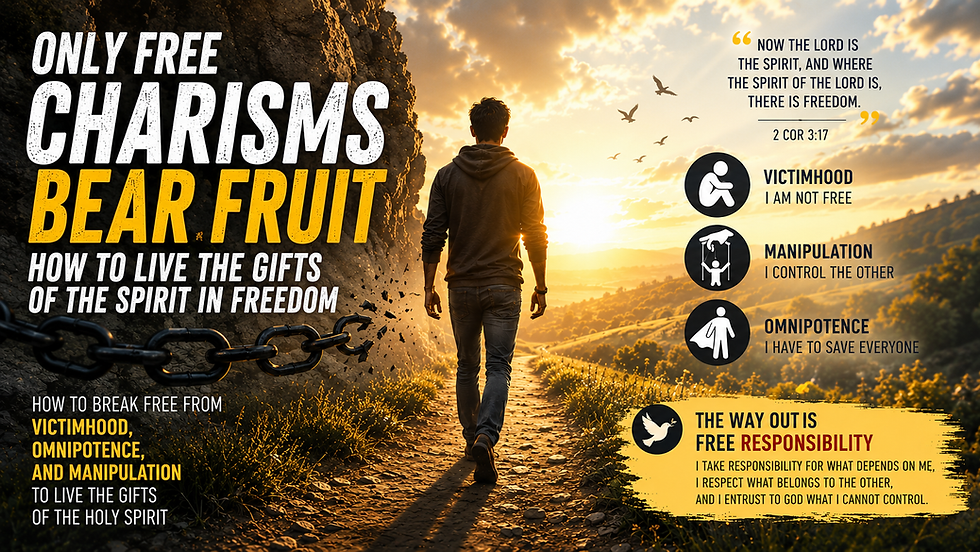
Receiving a charism is a gift. Learning to live it in freedom is a journey.
We may have had a genuine experience of the Holy Spirit, pray with faith, prophesy, evangelize, intercede, accompany others, and yet still carry within us wounds, a need for recognition, fear of abandonment, a desire for control, or the need to feel indispensable.
This does not necessarily mean that the charism is false. It means that God’s gift passes through a person who still needs to grow.
Saint Paul expresses this through a beautiful image:
“We have this treasure in earthen vessels.”(2 Corinthians 4:7)
The treasure is real. But so is the clay.
So the question is not only:
“What charism have I received?”
But also:
“How free am I when I exercise it?”
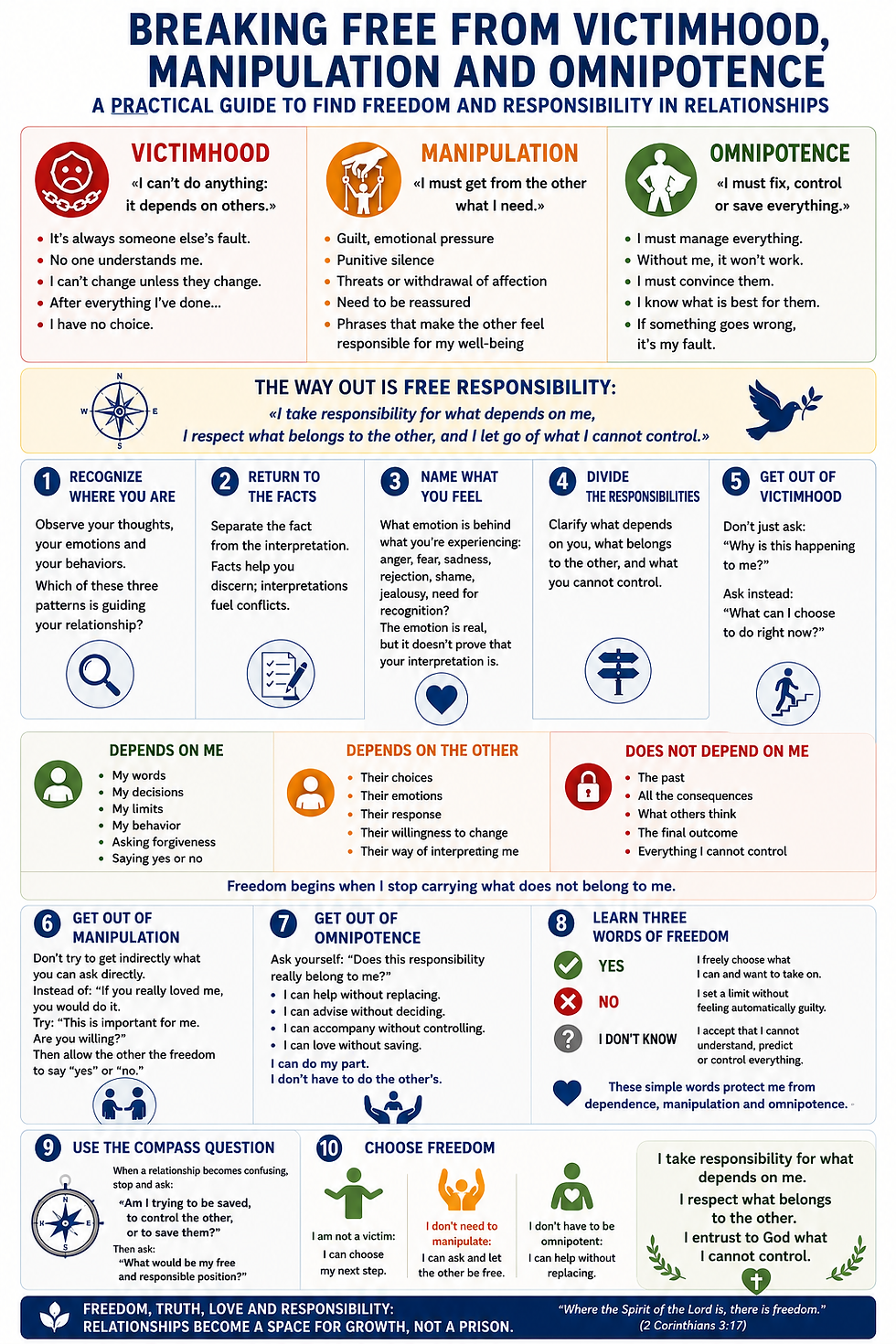
Three dynamics can imprison even a deeply spiritual person: victimhood, manipulation, and omnipotence.
The way out is what we might call free responsibility:
I take responsibility for what depends on me, I respect what belongs to the other person, and I entrust to God what I cannot control.
1. RECOGNIZE WHERE YOU ARE
The first step is not to change others. It is to recognize the position from which I am living a relationship.
Victimhood
“I can’t do anything about it; it all depends on others.”
I wait for others to change, understand me, recognize me, or repair what they have done to me before allowing myself to move forward.
Manipulation
“I have to get from the other person what I need.”
I may use emotional pressure, guilt, silence, threats of withdrawal, or even spiritual arguments to influence another person’s freedom.
Omnipotence
“I have to solve everything, control everything, or save everyone.”
I feel responsible for other people’s choices, reactions, and even their spiritual journey.
These three positions may seem very different, but they share a common root: they confuse what belongs to me, what belongs to the other person, and what belongs to God.
2. A CHARISM DOES NOT ERASE OUR WOUNDS
A powerful experience of the Holy Spirit does not automatically erase our personal history.
I can prophesy and still need approval.
I can pray for healing and still struggle to deal with rejection.
I can evangelize courageously and still fear abandonment.
I can lead a community and still feel the need to control everything.
I can serve generously and, unconsciously, need other people to need me.
Spiritual maturity begins when I stop using the charism to cover what still needs healing within me.
Introspective question
What happens inside me when my charism is not recognized, requested, or appreciated?
The answer may reveal much more than the charism itself.
3. COME BACK TO THE FACTS
One of the first safeguards against victimhood and manipulation is learning to distinguish facts from interpretations.
Fact: “The leader did not accept my proposal.”
Interpretation:“He doesn’t believe in my charism.”
Fact: “That person did not answer me.”
Interpretation: “She is rejecting me.”
Fact: “My prophetic word was not confirmed.”
Interpretation: “They are quenching the Spirit.”
The interpretation may be correct. But it may also be wrong.
This is why Saint Paul asks that even prophecy be discerned:
“Let two or three prophets speak, and let the others discern.”(1 Corinthians 14:29)
A mature charism is not afraid of discernment.
4. NAME WHAT YOU ARE FEELING
Before spiritualizing what is happening, ask yourself:
“What am I really feeling?”
Anger?
Fear?
Jealousy?
Shame?
A sense of exclusion?
Fear of losing my place?
A need for recognition?
Fear that someone will no longer need me?
The emotion is real and deserves to be acknowledged.
But there is an important distinction:
What I feel is real as an experience, but it does not automatically prove that my interpretation of the facts is true.
Not every discomfort is a spiritual attack.
Not every correction is persecution.
Not every boundary is rejection.
Sometimes the Holy Spirit uses precisely a frustration to reveal where we are not yet free.
5. SEPARATE THE RESPONSIBILITIES
This is one of the most important exercises for a missionary.
When facing a difficult situation, mentally divide everything into three areas.
IT DEPENDS ON ME
My words. My decisions. My boundaries. My behavior. Asking for forgiveness. Saying yes or no. The way I exercise my charism.
IT DEPENDS ON THE OTHER PERSON
Their choices. Their emotions. Their response. Their willingness to change. The way they interpret what I say.
IT DOES NOT DEPEND ON ME
The past. Every consequence. What others will think. The final outcome. Someone’s healing. Someone’s conversion. Everything I cannot control.
Freedom begins when I stop carrying what does not belong to me.
6. BREAK FREE FROM VICTIMHOOD: RECLAIM YOUR FREEDOM
Being genuinely wounded does not mean living as a victim.
Victimhood begins when the wound becomes the place from which I interpret everything:
“Nobody understands me.”
“They don’t recognize my charism.”
“After everything I have done…”
“I can only be well when that person changes.”
The question that breaks this pattern is not:
“Why are they doing this to me?”
but:
“What can I choose today, even if the other person does not change?”
I cannot force someone to recognize me.
I can stop living for their recognition.
I cannot force someone to ask for forgiveness.
I can begin my own journey of healing.
I cannot change the past.
I can refuse to let the past determine my entire future.
7. BREAK FREE FROM MANIPULATION: ASK WITHOUT POSSESSING
Manipulation is not always aggressive.
Sometimes it speaks an affectionate, spiritual, or even prophetic language.
“If you really loved me…”
“After everything I’ve done for you…”
“The Lord has shown me that you must…”
“If you leave this community, I don’t know whether you are still in God’s will.”
The problem is not having a need.
The problem is trying to take away another person’s freedom in order to satisfy that need.
A free request says:
“This is important to me. Are you willing?”
And then allows the other person to answer yes or no.
The same principle applies to prophecy.
Not:
“God told me that you have to do this.”
But:
“I believe I received this word. I offer it to you: pray about it and discern it before the Lord.”
“Test everything; hold fast to what is good.” (1 Thessalonicians 5:21)
A genuine charism serves freedom; it does not confiscate it.
8. BREAK FREE FROM OMNIPOTENCE: YOU DO NOT HAVE TO SAVE EVERYONE
Missionary omnipotence can be particularly seductive because it looks like generosity.
“I have to help him.”
“I have to convince her.”
“I have to stop this person from leaving.”
“Without me, they won’t make it.”
“If this person falls, it is my fault.”
But there is a liberating truth:
You are not the Savior. You are a disciple of the Savior.
You can help without taking someone’s place.
You can advise without deciding for them.
You can accompany without controlling.
You can pray without making yourself responsible for the outcome.
You can love without saving.
You can let someone go without abandoning them.
When Jesus encounters the rich young man, He proposes a path, loves him, and then respects his freedom to walk away (cf. Mark 10:21–22).
To love does not mean to control the outcome.
9. BEWARE OF THE TRIANGLE: VICTIM, RESCUER, ACCUSER
These roles can quickly turn into one another.
A missionary thinks:
“This person needs me.”
He becomes the rescuer.
He invests time, energy, and availability.
But the person does not change or chooses another path.
Then comes:
“After everything I have done for you!”
The rescuer becomes the victim.
And shortly afterward:
“You are ungrateful. You don’t want to change.”
The victim becomes the accuser.
The decisive question is:
“Am I serving freely, or am I unconsciously expecting recognition, loyalty, obedience, or dependence in return?”
Authentic charity does not send the bill afterward.
10. LEARN THREE WORDS OF FREEDOM: YES, NO, AND “I DON’T KNOW”
Charismatic maturity also passes through three very simple expressions.
YES
I freely choose what God entrusts to me.
NO
I recognize that some responsibilities do not belong to me.
Saying no does not necessarily mean loving less.
I DON’T KNOW
Perhaps this is one of the most spiritual things a charismatic Christian can learn to say.
I do not need to have a word for everyone.
I do not need to interpret every event.
I do not need to know the cause of every suffering.
I do not need to explain why someone is not healed.
I do not always need to know what God is doing.
Accepting mystery is also an act of faith.
11. THE CHARISMATIC CHRISTIAN’S COMPASS QUESTION
When a relationship becomes confused within a community or mission, stop and ask yourself:
“Am I trying to be rescued, manipulate the other person, control them, or rescue them?”
Then ask a second question:
“What would be my freest and most responsible response before God?”
And a third:
“Is this relationship making both of us freer, or is it creating dependence?”
These three questions can profoundly transform the way we accompany others.
12. THE FRUIT OF A CHARISM IS ALSO THE FREEDOM IT GENERATES
Jesus says:
“By their fruits you will know them.”(Matthiew 7:20)
We can apply this criterion to our ministry as well.
Are the people I accompany becoming:
freer or more dependent?
More capable of discernment or more dependent on my approval?
More attached to Jesus or more attached to me?
More responsible or more passive?
More capable of walking forward, or unable to choose without constantly asking me what they should do?
Authentic spiritual accompaniment should gradually make the accompanier less indispensable and the person’s relationship with God deeper.
The charism was not given to build our own centrality:
“To each is given the manifestation of the Spirit for the common good.”(1 Corinthians 12:7)
13. CHOOSE FREEDOM: YOU ARE AN INSTRUMENT, NOT THE SOURCE
This is the heart of the matter.
I am not imprisoned by victimhood: I can choose my next step.
I do not need to manipulate: I can ask and leave the other person free.
I do not need to be omnipotent: I can help without taking someone else’s place.
And above all:
I am not the source. I am an instrument.
I am not the Savior.
I am a witness.
I am not the owner of the charism.
I am the steward of a gift.
I do not have to convert everyone.
I am called to proclaim.
I do not have to heal everyone.
I am called to pray in faith.
I do not have to keep everyone from leaving.
I am called to love in truth.
I do not have to control the fruit.
I am called to faithfulness.
And here lies the great paradox of charismatic life:
The more we renounce omnipotence, the more room we give to the power of the Holy Spirit.
CONCLUSION — PAUSE BEFORE THE HOLY SPIRIT
Before thinking of someone else while reading this article, think about yourself.
Do not ask:
“Who do I know who behaves like this?”
Ask:
“Lord, where am I in these dynamics?”
Take a few minutes in silence.
Questions for personal reflection
1. What happens inside me when I am not recognized or appreciated?
2. What wound do I keep talking about without being able to let it go?
3. Do I need someone to need me?
4. Can I accept that someone I accompany may choose differently from what I advise?
5. Have I ever used the words “God told me” to give greater authority to my own opinion?
6. Can I receive correction regarding the way I exercise my charism?
7. When someone tells me “no,” do I truly respect their freedom?
8. What responsibility am I carrying today that actually belongs to someone else?
9. What situation am I trying to control because I am afraid to truly entrust it to God?
10. Are the people I serve becoming freer, or more dependent on me?
Three practical exercises
EXERCISE 1 — THE THREE COLUMNS
Take a sheet of paper and think of a relationship that is weighing on you right now.
Divide the page into three columns:
DEPENDS ON ME | DEPENDS ON THE OTHER PERSON | DOES NOT DEPEND ON ME
Place each element of the situation in the appropriate column.
Then choose one concrete action from the first column.
That is where your responsibility lies today.
EXERCISE 2 — TURN MANIPULATION INTO A REQUEST
Identify a phrase you tend to use when you feel hurt:
“After everything I’ve done…”
“If you really loved me…”
“You should understand…”
Turn it into a direct request:
“This is important to me. May I ask you…? You are free to say yes or no.”
Then notice what happens inside you when you genuinely allow the other person the freedom to respond.
EXERCISE 3 — GIVE BACK TO GOD WHAT YOU CANNOT CONTROL
Write down the name of a person or a situation that you are trying to save, change, or control.
Then pray slowly:
“Lord, I will do my part, and I give back to You what does not belong to me.I take responsibility for what depends on me.I respect what belongs to the other person.I entrust to You what I cannot control.”
And whenever the temptation returns to take everything back onto your shoulders, repeat:
“I do my part. God remains God.”
This is not giving up on the mission.
It is missionary maturity.
It is the freedom to serve without possessing, prophesy without imposing, accompany without controlling, and love without making ourselves indispensable.
“Where the Spirit of the Lord is, there is freedom.”(2 Cor 3:17)
The gifts of the Spirit reach their true fruitfulness when they are no longer used to compensate for our wounds, control others, or prove who we are.
The charism is a gift.Freedom is the soil in which it can bear fruit.


Comments