


Become the best version of you
Staying, loving, changing: where inner growth, neuroplasticity, and life in the Spirit meet

We are always talking about letting go.Far less about how to stay without ceasing to be yourself.
We talk about setting boundaries. But far less about how to open that door again when someone genuinely needs us.
We talk about cutting ties. But rarely about how to discern when a bridge is worth crossing again, after disappointment, hurt, or betrayal.
We constantly talk about recognizing a toxic relationship. And that is necessary. But how often do we talk about what it takes to build and nurture a healthy relationship?
We talk about starting over. Far less about how to keep going.
We talk about protecting ourselves. But not enough about how to learn to trust again without becoming naïve, without losing sight of reality.
We talk about setting boundaries. But how capable are we of apologizing when we are the ones who have crossed someone else’s boundaries?
Perhaps we have become very good at speaking the language of protection.
Now we also need to learn the language of maturity.
Because growing does not simply mean knowing what to walk away from. It also means learning what to move toward.
🧠The brain is not fixed: it can continue to learn
Neuroscience offers us something particularly important here: the brain retains the capacity for neuroplasticity even in adulthood.
What does that mean?
Neuroplasticity is the nervous system’s ability to modify its organization and the functioning of its networks in response to experience, learning, environment, and practice.
Put simply: what we experience and what we repeatedly do matters.
The brain is not a machine that is completed once and for all.
It continues to learn.
It continues to adapt.
Within certain limits, it continues to change.
This does not mean that we can simply “reprogram our brain” at will.
It does not mean that positive thinking is enough.
It does not mean that a deep wound disappears because we repeat a few motivational phrases in front of a mirror.
No slogans. No shortcuts.
Neuroplasticity tells us something far more serious: new experiences and new learning, especially when repeated, can gradually contribute to changing the way we respond.
And this is where neuroscience becomes particularly interesting for personal growth.
🔄Understanding is not enough: we need new experiences
You may fully understand why you are afraid of being abandoned and still feel afraid.
You may know where your difficulty trusting others comes from and still continue to shut people out.
You may understand every reason behind your anger and still explode.
You may have identified a childhood wound and, thirty years later, still react as though that situation were happening all over again.
Why?
Because understanding is essential, but understanding does not automatically produce change.
Awareness can open the door.
Then you have to walk through it.
Change also requires new experiences.
If for years you learned to run away whenever conflict arose, you will gradually need to experience that you can stay without losing yourself.
If you learned to please everyone because you feared rejection, you will need to practise saying no without believing that this makes you a bad person.
If a wound taught you that loving someone means being invaded or losing yourself, you will need to build relationships in which you can experience that intimacy and freedom can coexist.
If you learned to defend yourself by attacking, you will need to experience another kind of strength: expressing what you feel without destroying the person in front of you.
If you have learned to interpret every silence as rejection, you will need to pause before reacting and ask yourself:
“Is this really what is happening, or is my history interpreting what is happening?”
This is a crucial point:
It is not enough to understand differently. We gradually need to learn to live differently.
Attention, experience, and repetition can support new learning.
And this is precisely where neuroplasticity meets the work of personal transformation.
🌱 What protected you yesterday may be limiting you today
There is a question I consider essential when working with our personal history:
What if some of the behaviors you want to eliminate today were once attempts to protect you?
Someone who has been hurt may have learned not to trust.
Someone who has been abandoned may have learned to cling to others.
Someone who has been humiliated may have learned to hide.
Someone who has been betrayed may have developed an excessive need for control.
Someone who was never listened to may have learned to shout.
Someone who always had to be strong may find it extremely difficult to ask for help.
Someone who lived with constant unpredictability may continually try to control people and situations.
This does not mean that every behavior should be justified.
Understanding does not mean excusing.
It means asking yourself:
“What am I trying to protect when I react this way?”
Sometimes a response that once helped you survive emotionally can become a prison today.
Maturity begins when you can say:
“This response protected me then. I respect what it did for me. But today I can learn a different way of responding.”
And that is where a new space begins to open.
The space of freedom.
❤️Becoming the best version of you does not mean becoming someone else
There is a profound difference between transformation and self-rejection.
Growing does not mean creating a perfect version of yourself.
It does not mean erasing the past.
It does not mean having no more weaknesses.
It does not mean becoming the person other people want you to be.
Nor does it mean constantly comparing yourself with an ideal, unattainable version of yourself.
Becoming the best version of you means allowing who you are to mature.
Being sensitive without being overwhelmed by your sensitivity.
Being strong without becoming hard.
Being generous without allowing yourself to be used.
Setting boundaries without building walls.
Forgiving without denying the truth.
Trusting without becoming naïve.
Speaking the truth without deliberately hurting others.
Loving someone without abandoning yourself.
Staying when staying is worthwhile.
Leaving when staying would mean destroying yourself.
And, above all, understanding this:
You are not condemned to repeat forever what you learned yesterday.
Your history explains many of your reactions.
But it does not have to determine your entire future.
✝️ “Be transformed by the renewing of your mind”
For Christians, all of this also opens up an extraordinary spiritual perspective.
Saint Paul writes:
“Do not conform to the pattern of this world, but be transformed by the renewing of your mind.”(Romans 12:2)
We need to be clear: faith cannot be reduced to neuroscience, and neuroscience does not prove faith.
They operate on different levels.
Yet there is something deeply meaningful about contemplating the human person as created with a genuine capacity for learning, adaptation, relationship, and transformation.
Grace does not destroy our humanity.
It passes through it.
It heals it.
It gives it direction.
It gradually leads it toward fullness.
The Holy Spirit does not want to create an artificial personality to replace yours.
He wants to lead you toward greater freedom so that the person you are called to become can increasingly emerge.
This is why Christian transformation cannot simply mean:
“I need to behave better.”
It goes much deeper.
It means renewing your mind.
Learning to recognize what is happening within you.
Healing the way you relate to others.
Exercising your freedom.
Learning new responses.
Allowing grace to reach even those places where you automatically defend yourself, run away, control, or attack.
It means gradually orienting your entire life toward love.
🔥 Transformation requires practice
A Masterclass can open your eyes.
A retreat can awaken a new awareness.
A teaching can bring clarity.
A word can touch you deeply.
A moment of prayer can become a turning point in your life.
But then comes Monday morning.
The person who irritates you shows up.
The phone rings.
The conflict returns.
Someone becomes silent.
Fear appears.
Suddenly, you find yourself in exactly the kind of situation where the old automatic response comes back.
And that is precisely where the training begins.
It is not enough to say:
“I understand that I need boundaries.”
You need to learn how to set them.
It is not enough to say:
“I understand that I need to trust.”
You need to gradually experience relationships in which trust becomes possible, while maintaining discernment.
It is not enough to say:
“I have to stop reacting this way.”
You need to build, practise, and repeat another possible response.
And when you fall back into the old pattern, it does not necessarily mean that all your work has been lost.
It may simply mean that this new way of living still needs practice and consolidation.
Do not ask yourself only:
“Why did I fall into this again?”
Also ask:
“What can I practise differently next time?”
That question changes everything.
Because it moves you from condemnation to responsibility.
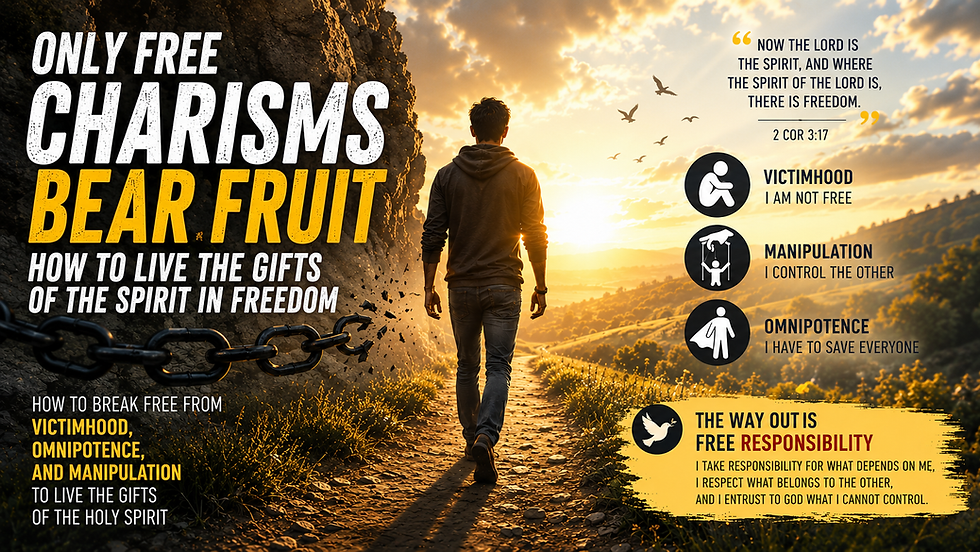
🕊️You do not have to become perfect. You need to become freer.
Perhaps the real question is not:
“How can I become someone else?”
The question is:
“What part of me still needs to mature so that I can fully become the person I am called to be?”
Perhaps you need to learn to stay.
Perhaps you need to learn to leave.
Perhaps you need to forgive.
Perhaps you need to set a boundary.
Perhaps you need to stop trying to control everything.
Perhaps you finally need to make a decision.
Perhaps you need to learn to love someone without constantly trying to save them.
Perhaps you need to stop confusing love with the need to be indispensable.
Or perhaps, for the first time, you need to learn how to let yourself be loved.
The path is not the same for everyone.
But one principle remains:
What you have lived through has helped shape you, but it does not have to determine everything you will become.
Your story belongs to you.
Your wounds are part of your story.
Your mistakes are part of your story.
But your wounds are not your whole identity.
And the Gospel adds something that no personal-development technique can promise:
“Behold, I make all things new.”(Revelation 21:5)
🌟 It is time to become the best version of you
Not the perfect version.
Not the version you create to please others.
Not the version that never makes mistakes.
Not the version that never suffers.
But the version that is freer, more self-aware, more capable of loving, more open to the Holy Spirit, and more ready to live your mission.
The EMMAUS COM Masterclasses were also created for this purpose: to provide spaces where faith, formation, experience, personal growth, and life in the Spirit can meet.
We do not simply want to talk about change.
We want to learn how to live it, practise it, and consolidate it, so that what we understand can gradually become a new way of thinking, choosing, loving, relating, and serving.
Renew your mind. Learn to love. Live your mission.
And begin, one step at a time, to become the best version of you.
🧠🌱 PRACTICAL EXERCISE
TRAIN A NEW RESPONSE
From an old automatic pattern to a freer choice
Do not try to change ten things at once.
For this week, choose just one.
Take a notebook. Give yourself a few minutes of silence and ask the Holy Spirit to help you look at yourself truthfully, without judging yourself.
Then begin.
1. IDENTIFY YOUR AUTOMATIC PATTERN
Complete this sentence:
When __________________________,
I automatically tend to __________________________.
For example:
When I feel criticized,
I immediately tend to defend myself and attack.
Or:
When someone becomes distant from me,
I immediately think they no longer want me.
Do not analyze it yet.
Simply observe.
2. ASK YOURSELF WHAT YOU ARE TRYING TO PROTECT
Now slowly ask yourself:
“What is this reaction trying to protect me from?”
Rejection?
Abandonment?
Humiliation?
Failure?
Loss of control?
The feeling that you are not good enough?
Write down whatever emerges.
You do not need to accuse yourself.
You need to understand yourself more deeply in order to become freer.
3. CHOOSE A NEW RESPONSE
Now complete this sentence:
The next time __________________,
instead of __________________,
I will try to __________________.
Choose something small, concrete, and realistic.
For example:
When I feel criticized, instead of responding immediately, I will take three breaths, listen until the other person has finished, and then try to express calmly what I think.
This is the response you are going to begin to practise.
4. PRACTISE IT FOR SEVEN DAYS
Every evening, stop for five minutes and ask yourself:
“Did I have an opportunity today to practise my new response?”
If you succeeded, write down what happened.
What did you feel?
What did you do differently?
What effect did it have?
If you fell back into your old automatic pattern, do not turn the mistake into self-condemnation.
Ask yourself:
“At what point could I have chosen differently?”
Then spend a few moments imagining how you might have responded.
The goal is not to be perfect for seven days.
The goal is to begin bringing into awareness what was previously automatic and practising an alternative.
These seven days are not a scientifically established period required to “reprogram” your brain. They are simply the beginning of a practice that can continue over time.
5. BRING YOUR NEW RESPONSE INTO PRAYER
Each morning, read again the response you have chosen to practise. Then pray:
Holy Spirit, renew my mind. Show me today the moment when I am tempted to repeat my old pattern. Give me the freedom to pause before I react. Shine your light on what is happening within me and teach me a new way to respond. I do not want to be a prisoner of my history: I want to learn from it. Teach me to love without losing myself, to set boundaries without closing my heart, to forgive without denying the truth, and to trust without abandoning discernment. Day by day, shape within me the person You are calling me to become. Renew my mind, heal my heart, and make me available for the mission You have prepared for me. Amen.
✍️ THE SEVEN-DAY QUESTION
At the end of the week, read through what you have written.
Then spend a few minutes in silence and answer this question:
“If I continued practising this new response over the coming months, what kind of person could I become?”
Do not ask yourself only:
“What do I need to stop doing?”
Ask yourself:
“What do I want to learn to become?”
Because transformation is not only about leaving an old path behind.
It is about walking a new path long enough for it to gradually become more familiar.
And perhaps today you can take the first step.
Not to become someone else.


Comments